
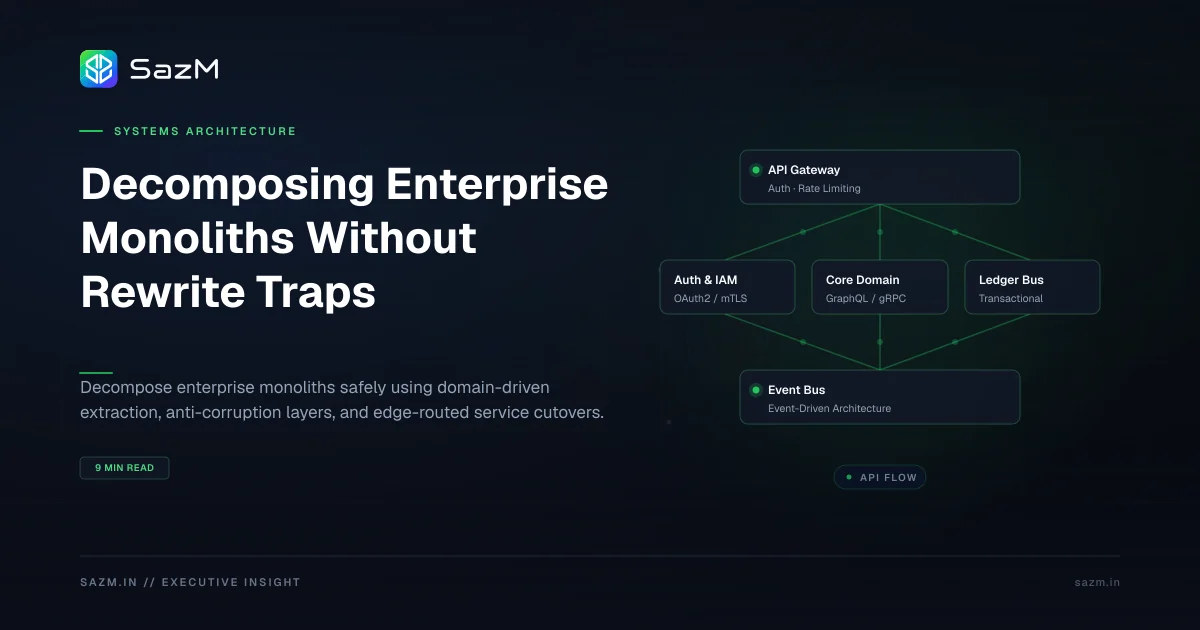
Many engineering organizations attempt to escape monolithic friction by decomposing their entire system into dozens of microservices simultaneously. Without clear domain boundaries, this merely converts in-process function calls into fragile, high-latency HTTP or gRPC network requests with distributed transaction complexity.
Domain-Driven Boundary Identification
SazM approaches decomposition by profiling change frequency and operational contention:
- High Friction / High Velocity: Services that deploy multiple times daily and suffer deployment queue bottlenecks (e.g. Lead Intake, User Onboarding).
- High Contention / High Latency: Services that hold long-running database locks or interface with unstable third-party APIs.
- Stable Core: Core accounting or ledger tables that change rarely and operate reliably within the monolith.
The Anti-Corruption Layer (ACL)
When modern services must read or write data shared with the legacy monolith, an Anti-Corruption Layer translates between domain models:
export function adaptLegacyUserData(legacyRow: Record<string, any>): CanonicalUser {
  return {
    id: legacyRow.vch_user_uuid || legacyRow.int_user_id.toString(),
    email: legacyRow.txt_email_address.trim().toLowerCase(),
    tier: legacyRow.int_status === 1 ? 'enterprise' : 'standard',
    createdAt: new Date(legacyRow.dt_created).toISOString(),
  };
}
By isolating the modern schema from legacy naming idiosyncrasies, the modern system remains clean and verifiable.
Event-Driven Decoupling via Transaction Outbox
Instead of cross-database transactions, publish domain events to an Outbox table:
BEGIN TRANSACTION;
UPDATE orders SET status = 'shipped' WHERE id = ?;
INSERT INTO domain_events (id, topic, payload, created_at)
VALUES (uuid(), 'order.shipped', json_object('order_id', ?), datetime('now'));
COMMIT;
A background worker polls the outbox and streams events to downstream services with guaranteed delivery.
Surgically Modernize Enterprise Monoliths
Extract core domain boundaries safely with senior architects. Preserve business revenue while retiring tech debt.
Modernize Your Monolith Today →Architectural Invariant · Production Hardening
Production systems do not fail uniformly; they fail at unmonitored integration boundaries, unbudgeted retry loops, and unbounded queue states. Architectural guarantees require deterministic circuit breakers, immutable telemetry, and strict isolation between synchronous user pathways and background mutations.
Advanced MD
Secured and optimized clinical practice management and EHR data-modeling systems to streamline medical workflows.
Continue Reading
The Strangler Fig Pattern: Decoupling Monolithic APIs
Safely modernize legacy PHP and monolithic APIs using Cloudflare Workers edge facades and the Strangler Fig pattern with zero downtime.
Legacy Modernization vs Complete Rebuild
Analyze the trade-offs and risks when deciding whether to modernize a legacy platform incrementally or perform a high-risk full platform rebuild.
Facing a similar architecture or production reliability challenge?
Describe your technical bottleneck, current architecture, and target milestones. SazM evaluates your system with senior principal engineer oversight — zero sales reps, zero simulated capacity.